Sequencer · 32 HP
NerdSEQ
Not just a tracker
Built to sequence the modular — and everything else in the room, too.
Time runs down the screen and voices across it, so you read a whole arrangement at once instead of scrolling a piano roll sideways. Typing is faster than turning knobs, and a pattern you can read is a pattern you can change mid-set. If you have written music in Fasttracker 2, Impulse Tracker or Little Sound DJ, you already know how this works. If not then don’t worry.
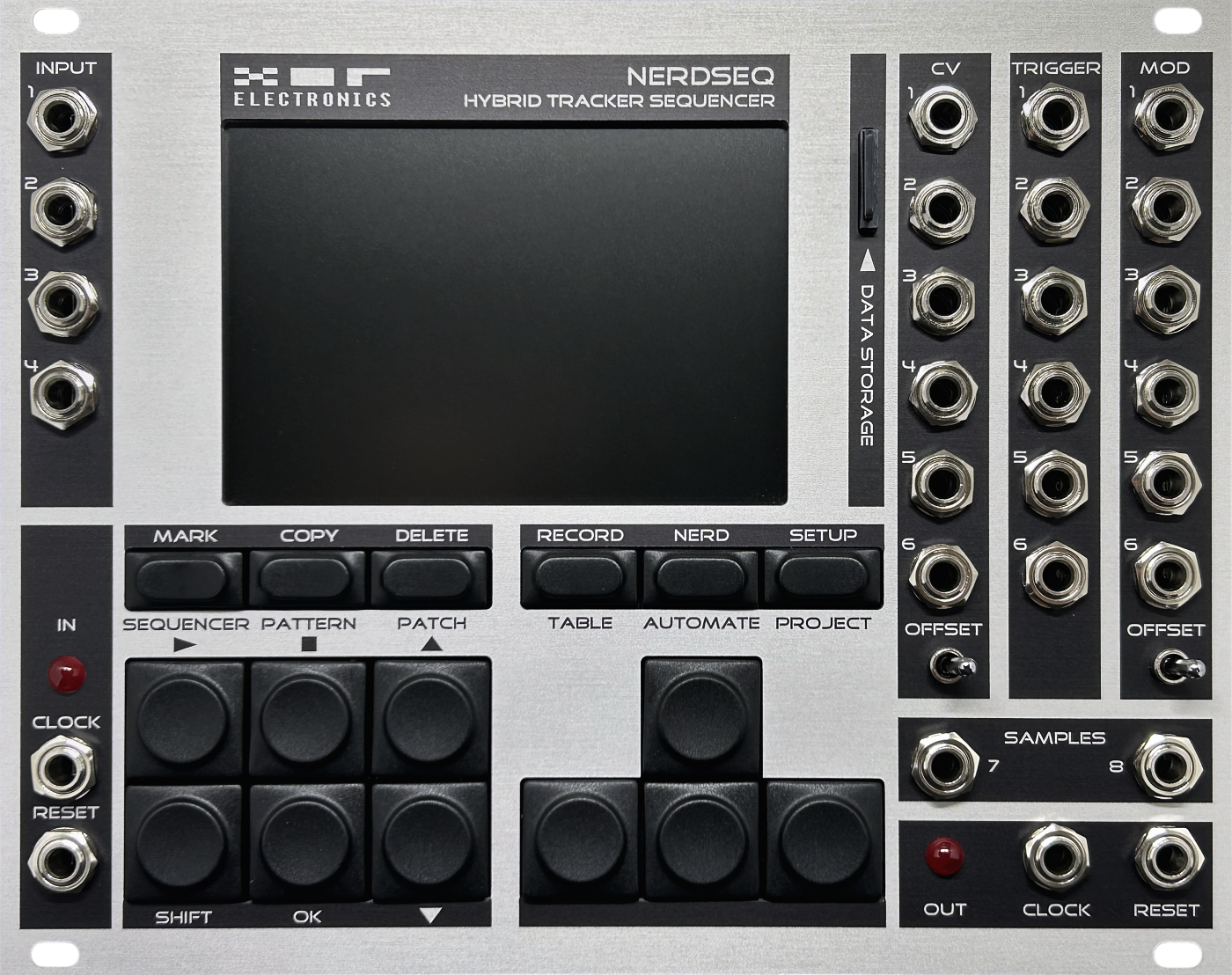
On its own it drives eighteen outputs of CV, triggers and modulation from six tracks, with four assignable inputs, clock and reset both ways, and two pairs of audio tracks for samples, the built-in oscillators and four-operator FM synthesis.
Then it keeps going. Add expanders and the same tracker sequences MIDI gear polyphonically across channels, I2C devices, Tiptop’s ART protocol, HDMI video with a shader-based visual synthesizer behind it, and up to sixty-four further CV and gate outputs. The Launchpad integration is just one way to perform. That’s the actual claim: whatever is in the studio, NerdSEQ can sequence it.
The firmware has been developed continuously since the first release in May 2017 and is free for the life of the module — more than thirty releases so far, all of which run on a first-run unit. The release notes are the full record. It’s the first hardware tracker there’s been.
Sequencing
- Notes, CV, drums, automation, envelopes, LFO, modulations
- Quantise, ratchets, glide, arithmetics, groove, probability
- Per-track divider/multiplier, order, random, spiral, backward
- Polyrhythmic patterns, Euclidean rhythms, generative sequencing
- Fill, CV record, sequencers in a sequencer, drum matrix
- A modulation matrix flexible enough for algorithmic execution
- Typed, played live or generated
Sound on board
- 4 oscillators — sine, triangle, sawtooth, pulse and noise.
- 4-operator FM synthesis.
- 12 sample slots; WAV files, looping, granular
- Two audio outputs, fed by two pairs of audio tracks.
- Distortion, bitcrush, wavefolder, delay, PWM, Hardsync
What else it can drive
- MIDI — multitrack, multichannel, polyphonic, with recording, MIDI effects and modulation.
- I2C and ART — polyphonic sequencing/modulations via I2C or ART
- Video — HDMI or composite, clone to a big screen, with an integrated video synthesizer modulated by events or sequenced as a track type.
- More voltage — up to 64 further outputs across the expander range.
- Controllers — Launchpad integration, a USB keyboard, or a Sega gamepad.
- Oscillators — a tightly integrated multi-oscillator synth voice via the Dualchord expander.
Memory
- 239 sequencer rows and 175 patterns of up to 64 steps.
- 176 patches, 32 tables of up to 16 steps, 8 automation slots with LFOs and 8 ADSR envelopes.
- As many projects as the microSD card holds, and the card is on the front panel.
Specifications
| Status | Shipping since 2017 |
| Width | 32 HP, 25 mm deep |
| Front panel | Black, grey, mix |
| Display | 3.5″ colour full-angle TFT, 480 × 320 |
| Controls | 10 full-size and 6 half-size buttons |
| CV inputs | 4, range 0 … +10 V |
| CV outputs | 12, range −5 … +5 V or 0 … +10 V |
| Gate out | 6 trigger/gate, 5 V |
| Audio out | 2 outputs, −5 … +5 V |
| Sync | Clock and reset, in and out, 5 V |
| Jacks | 28 × 3.5 mm mono |
| Storage | microSD, front panel |
| Expansion | 2 ports, up to 5 extensions |
| Power | ≈150 mA (+12 V), ≈32 mA (−12 V) |
- User manual
- Firmware and downloads
- Tutorial videos
- The expander range
- Plan a rack with it on ModularGrid
Prices and stock are in the shop, so what you see there is always current. Local dealers are on the distributors page.