Legacy · never released
Nerdsynth
A portable digital tracker groovestation with swappable sound chips, built between 2013 and 2016. It never became a product. The NerdSEQ came out of it, and that turned out to be the better idea.
On 14 March 2013, Jan Trompper and Thomas Margolf started a group to develop something they described, in the first post, as digital, a tracker, and a groovestation — in that order. The reasoning was straightforward: they wanted a hardware instrument they would actually want to use on stage, and nothing quite like it existed. A day later came the amendment that it should be as DIP as possible, which tells you the sort of project it was going to be.
What followed was three and a half years of prototypes built in a studio in Rotterdam Charlois, played at chiptune shows across Europe, funded for a while by a Dutch design grant, and eventually overtaken by its own side project.
A tracker, first and last
The interface was never up for debate. A tracker puts time down the screen and voices across it, and the goal was that a chiptune musician should already know how to drive it. Little Sound DJ and Little Piggy Tracker were the reference points, with Fasttracker 2 and Impulse Tracker further back.
By March 2014 the pattern screen was playing: notes, instrument, volume, and effects — and then a decision about how to arrange the remaining effect columns and groove, which is exactly the kind of question that decides whether a tracker feels right. One explicit rule was set early and kept: no quadruple functions per key. The most-used operations got their own buttons.
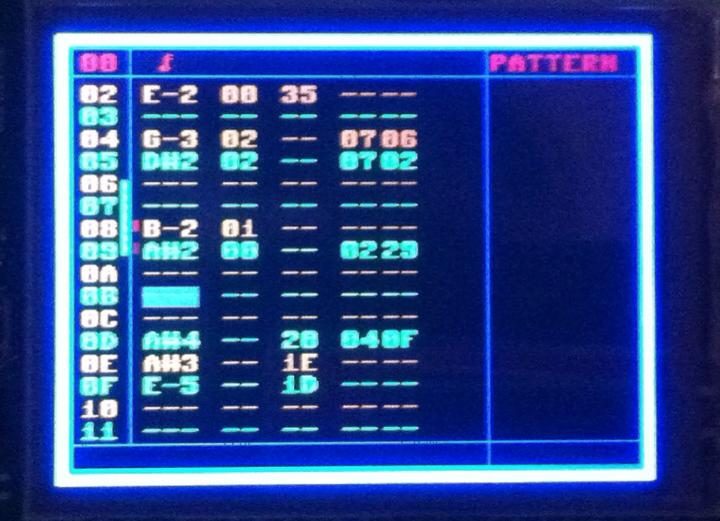
Then the rest of it, over about eight weeks: an instrument screen, song mode, live mode, pattern cloning, and tables — which for a chiptune musician means wavetables, arpeggios and rapid effect changes, and which arrived in May 2014 to some genuine enthusiasm. A drum screen turned up two days after the others, having been forgotten.
The hardware kept changing
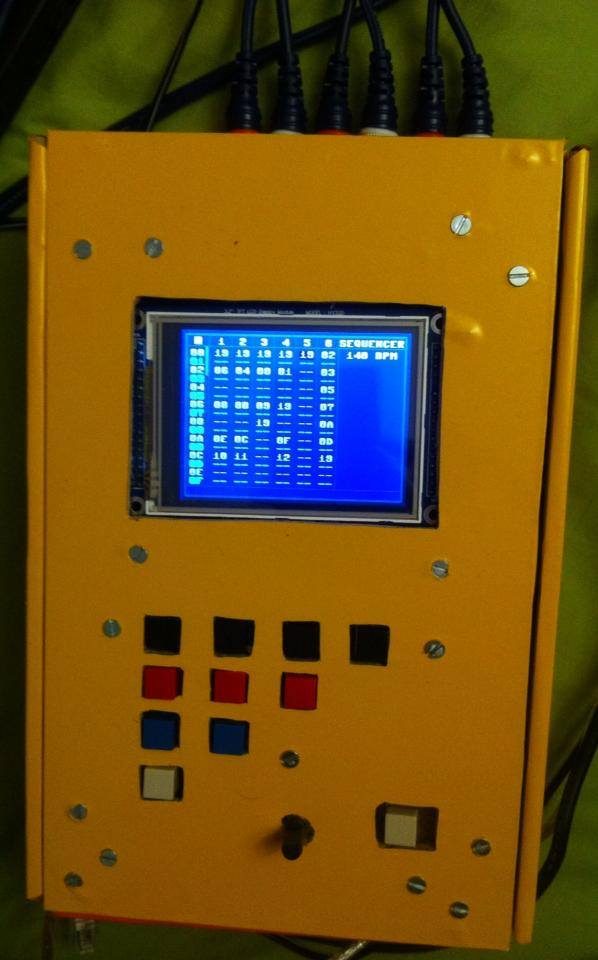
The first prototypes were built to be played rather than to be finished. A yellow case with buttons appeared in mid-2014 and went straight on stage — Rotterdam in May, Hamburg in June, and after that Copenhagen, Manchester, Amsterdam, Trier. The Hamburg gig got it declared officially stage-proofed, which is the sort of thing you can only say about hardware you have carried somewhere yourself.
Sound cartridges
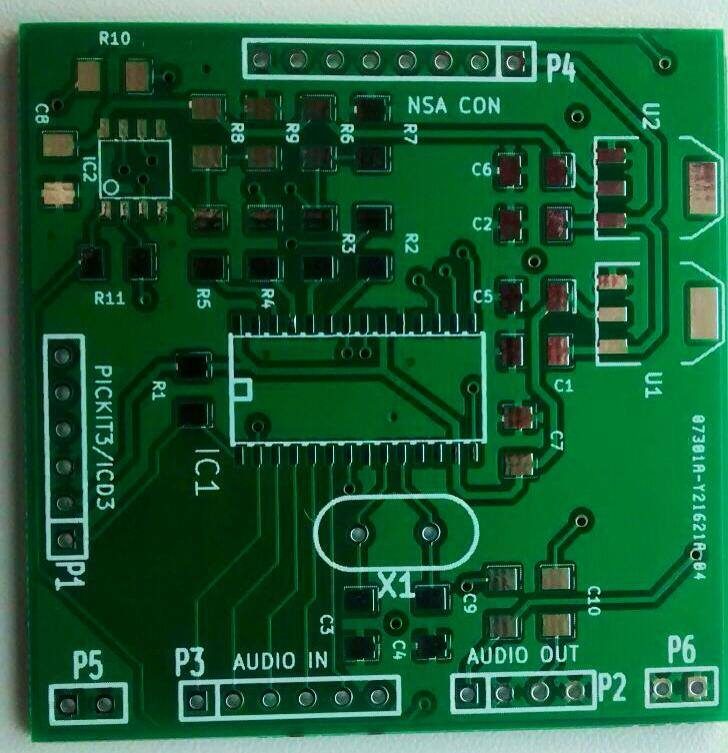
This was the idea that made the project interesting, and the one that made it hard. Rather than fixing the sound generation in silicon, tracks would be populated by plug-in cards — the Nerdsynth Sound Adapter, or NSA. Through 2015 they were prototyped and soldered one at a time:
- ATMegatron — Soulsby’s 8-bit monosynth, with customised firmware. Every Nerdsynth demo up to that point was six of these.
- DSP-G1 — a virtual-analogue modelling chip, five-voice paraphonic with a resonant low-pass filter.
- Soundgin SSG-01 — six voices of synthesis, sound effects, and English speech with an unlimited vocabulary.
- MeeBlip Anode — a dual-oscillator digital monosynth with an aggressive Twin-T analogue filter.
- SID — the Commodore 64 chip, included because the range would not have been complete without it.
- CV/Gate and a blank DIY card, for modular and for people who wanted to build their own.
The name outlived the machine. The NerdSEQ’s expander bus is still the NSA port, and its expanders are the same idea in a different shape: capability you plug in later rather than pay for up front.
A grant, and a real prototype
In June 2015 the Nerdsynth was selected for the Amsterdam Dance Event Sound Lab, with funding from the Stimuleringsfonds Creatieve Industrie — the Creative Industries Fund NL. That paid for the prototype that had been the goal all along: a properly manufactured board rather than something hand-wired, assembled at a production facility partly to find out what building it at scale would involve.
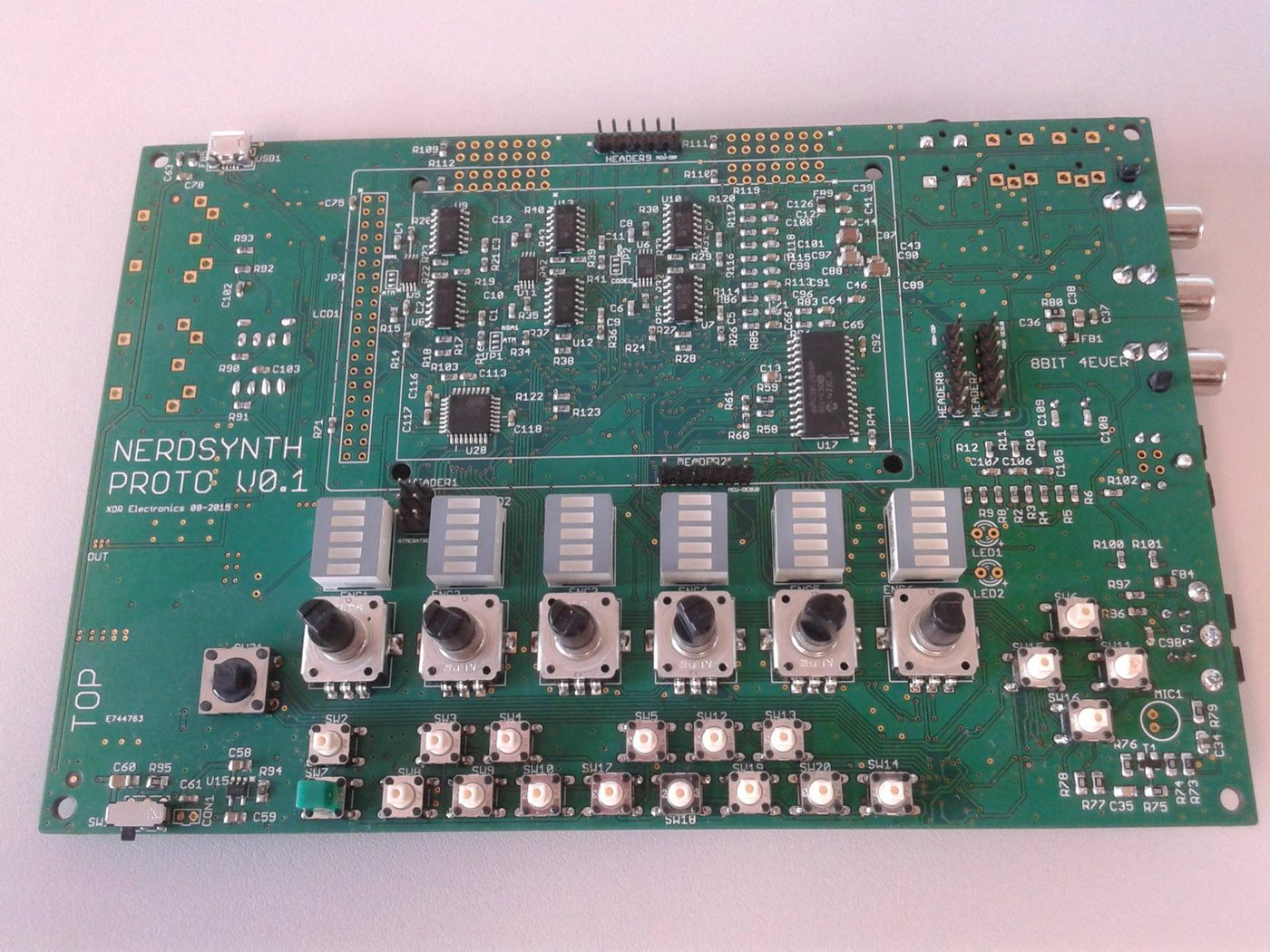
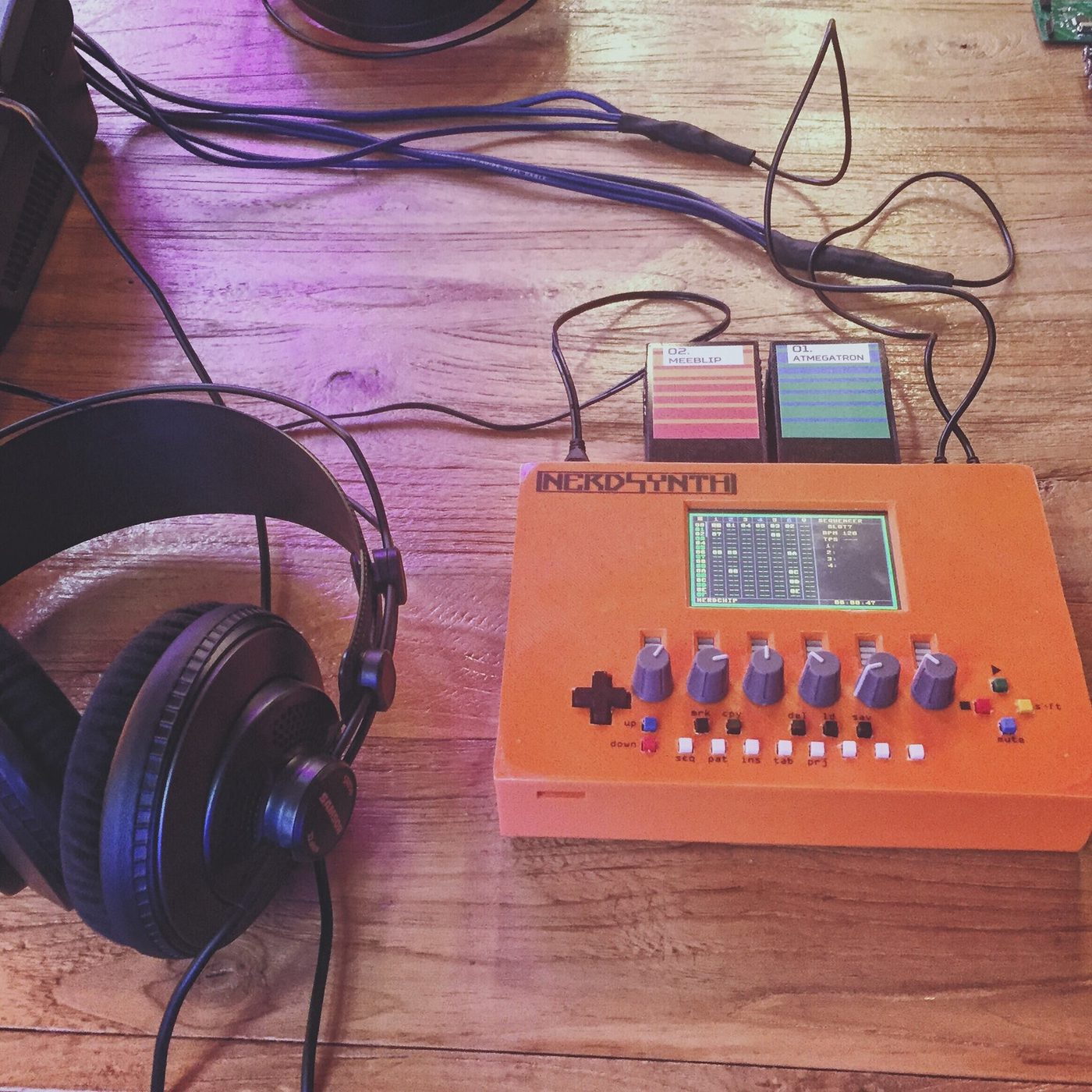
Three days at the Compagnietheater in Amsterdam, alongside Moog and Roland gear, with the prototype out on a table for anyone to play. It went well. People liked it.
Video came next. By January 2016 the tracker screen was appearing on a television, and by March the visuals were being sequenced from the tracker itself — two visual tracks alongside the audio ones, generating images from pattern data. Early and rough, but working.
Why it became the NerdSEQ
By May 2016 the honest assessment was in the updates themselves: analogue filter tests, a new cartridge connector, new buttons, and development slower than expected. A standalone instrument needs a case, a power supply, a battery, a keyboard mechanism, a touchscreen, cartridge economics — and all of that sits between you and the thing you actually wanted to build, which was the tracker.
In June 2016, waiting on a schematics review, there was a mention of a secret related project. It surfaced properly on 30 July:
It’s called the ‘Nerdseq’ and it is a Eurorack sequencer module based on the Nerdsynth. […] I got already 5 prototypes ready assembled and one got already a sign of life — I just put the recent Nerdsynth Firmware in there.
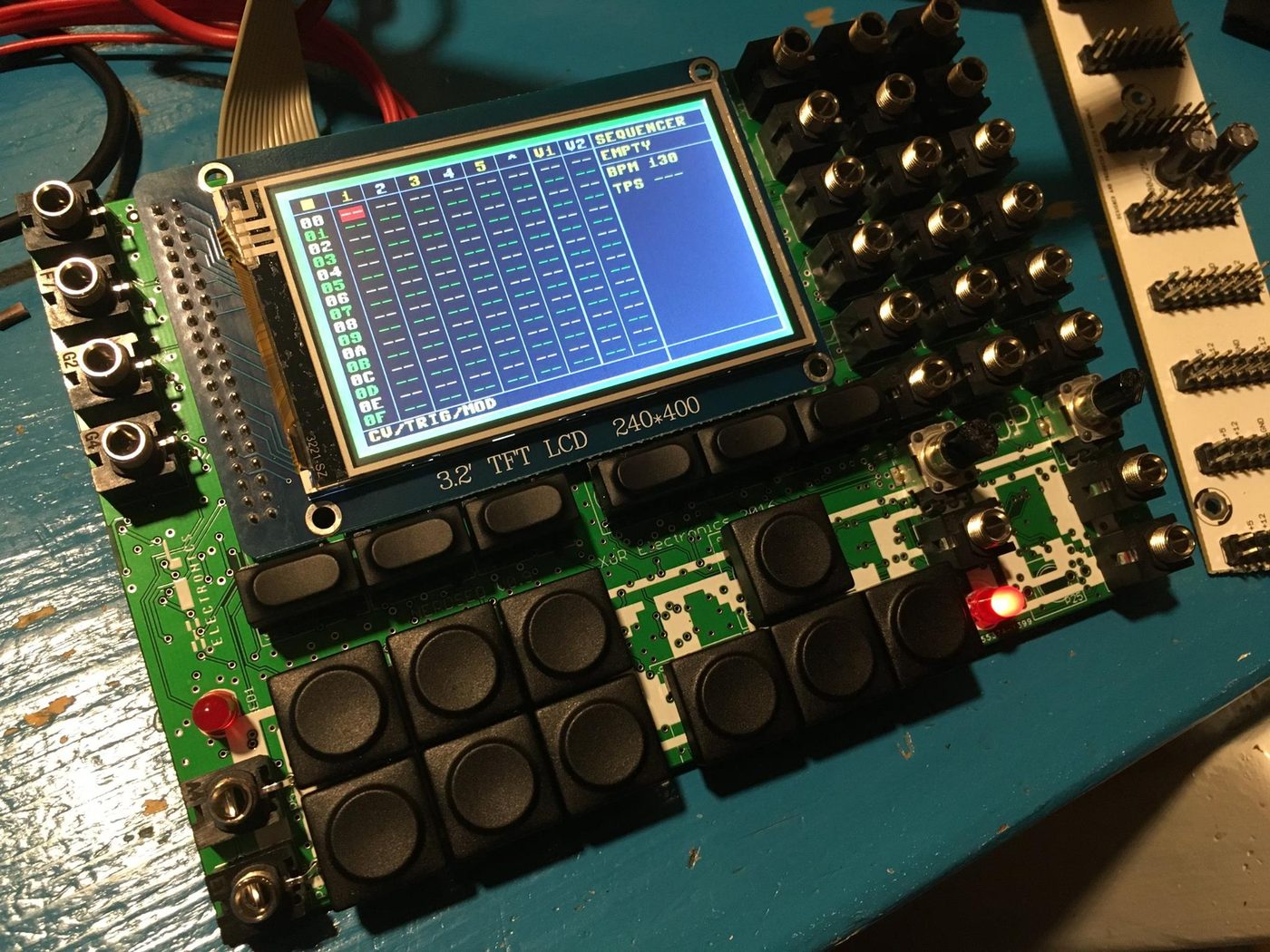
That last detail is the whole story. The Nerdsynth firmware ran on the NerdSEQ unchanged, because the firmware was the instrument — everything else had been packaging. Putting it in a Eurorack module meant the case, the battery, the power supply and the keyboard became somebody else’s problem: the rack already provides them. What was left was the part that mattered.
It shipped in 2017. The December 2016 update put it plainly — both projects share the same code base, so no time was wasted, and there was a lot of code to write.
The Nerdsynth has never been formally cancelled. It was overtaken, and the honest position is that it stayed overtaken: the NerdSEQ turned into a full-time job, in the good way. A 2020 update teasing the NerdSEQ Portable described it as a step closer to the Nerdsynth rather than the thing itself, and that one did not ship either.
What survived
- The tracker. The March 2014 pattern screen is still the shape of the NerdSEQ sequencer screen.
- Dedicated buttons. Set as a rule in 2013 and never relaxed.
- The NSA bus. Sound cartridges became expanders — same name, same principle.
- Video as a track type. Prototyped in 2016, shipped in the Video-IO expander, and grown into a shader-based video synthesizer in firmware v3.0.
- Tables, groove, arpeggios. Built in 2014 for chiptune musicians, still there.
- The firmware itself. One code base, continuously developed since 2013 — which is why a NerdSEQ from the first production run still runs the current release.
The through-line is that none of this was a roadmap. It was two people, and later one, building the instrument they wanted, and noticing partway through that a smaller version of it was the thing everybody else wanted too.
Jan Trompper co-founded the project in 2013; Bram van Oort joined in mid-2014 to look after the website and, by his own job description, to bring beer. XOR Electronics has been one engineer since.